
iManage MCP Server Is Here. But the Real Story Is What We've Already Learned Getting There

iManage’s announcement that the MCP Server is now generally available to all Cloud customers is a major milestone. But for many organisations, this raises a more important question: “What does this actually change in the real world?”
At OIA, we’ve been working through that question for months — alongside our customers — across early access programs, real integration efforts, and evolving AI strategies.
This isn’t a theoretical view: this is what happens when you try to make AI actually work in a governed, enterprise environment.
The Starting Point: AI Was There — But Disconnected
Across every conversation we had — whether with legal, accounting or professional services firms — the starting point was similar. Copilot was being rolled out, ChatGPT and Claude were being trialled. Specialist AI tools were entering the mix.
But the same problem kept surfacing - AI tools were powerful… but disconnected from the organisation’s knowledge.
Each platform needed its own integration, raised new security and governance questions and often led to workarounds when users couldn’t access what they needed.
This wasn’t an AI problem. It was a knowledge access problem.
The Shift: From “AI Tool” to AI Ecosystem
As we worked through discovery sessions and workshops, something became clear very quickly, organisations were not going to standardise on a single AI platform.
In fact, the opposite was happening. Some teams preferred Copilot, others were seeing stronger results from ChatGPT or Claude, some were exploring specialist legal, account or professional AI tools.
This wasn’t fragmentation — it was reality.
And it led to an important shift in thinking: AI is not a tool, it’s an ecosystem where:
AI platforms act as orchestrators
Agents perform specific tasks
And enterprise systems hold the real knowledge
Enter MCP: The Missing Layer
Model Context Protocol (MCP) started to appear in conversations as the way to connect this ecosystem. Not as another integration but as a standardised approach to connecting AI to enterprise knowledge.
In practical terms, what stood out early was:
One connection instead of many
No requirement to move or duplicate content
Existing permissions and governance still applying
The ability to connect multiple AI tools to the same source
The concept was simple but the implications were significant.
From Concept to Reality: What We Saw in the Field
Through early access engagement and hands-on work with customers, we moved beyond theory into practical application.
Introducing MCP in Real Conversations
In early sessions, MCP wasn’t positioned as a product feature. It was positioned as a way to answer a common challenge: “How do we connect all these AI tools to our iManage content without losing control?”
That framing changed the conversation from: Which AI tool is best? To: How should AI interact with our knowledge?
Multi-AI Strategy Became the Norm
One of the most consistent patterns we observed was that customers weren’t choosing between Copilot, ChatGPT, or Claude. They were using multiple — often simultaneously and in some cases, dissatisfaction with early AI initiatives (where expectations didn’t match outcomes) led to renewed interest in MCP as a way to reset the approach.
Not because the AI failed — but because the connection to the right knowledge wasn’t there.
Hands-On MCP Integration Work Changed the Thinking
As we worked through early MCP integration efforts, particularly with Copilot and other orchestrators, a few realities became clear:
The integration is not “just switch it on”
There are real considerations around:
> authentication
> user experience
> how AI triggers actions against enterprise data
Early limitations and quirks need to be understood and managed
MCP is simple conceptually — but its real value comes from how it’s implemented and used.
The Architecture Became the Enabler
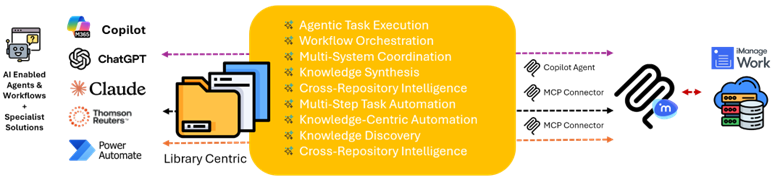
Through workshops, demos and integration work, a consistent architecture emerged:
iManage as the governed knowledge layer
MCP as the access layer
AI tools as the execution layer
Plugging into MCP wasn’t the strategy, it was the foundation that made the strategy possible. The architecture became the foundation and enabler — allowing organisations to move from experimentation to execution, without being held back by integration complexity or governance risk.
What Changed for Us (and Our Customers)
Through this journey, our perspective shifted. We moved from talking about AI tools to designing AI-connected knowledge environments. From demonstrating features defining practical, high-value use cases and from responding to AI hype to helping organisations establish real foundations for AI adoption.
Why iManage MCP Server Being Generally Available Matters
Now that the iManage MCP Server is generally available, the barrier to entry has changed. Organisations can enable MCP in their environment, begin connecting AI tools quickly, avoid building custom integrations for every new platform all while maintaining governance and control over their content.
But availability is not the same as value. Value comes from understanding how to use MCP as part of an AI strategy — not just enabling it.
Where OIA Fits
This is exactly where we’ve been operating. Across early access programs, client workshops and discovery sessions, integration and architecture discussions we’ve built a practical understanding of where MCP fits, works (and what doesn’t) and how to align AI capability with real business outcomes.
This allows us to support customers across three key areas:
Strategy Clarifying what’s possible, what’s practical and what should come next.
Architecture Designing MCP-enabled integrations, secure, governed AI access patterns and scalable approaches to multi-AI environments.
Execution Delivering pilot use cases, integration frameworks and adoption & enablement support.
If MCP Is Now on Your Radar
MCP is a major step forward in making that possible but it’s not the end of the journey; it’s the point where AI strategies can finally be built on a solid, governed foundation.
The most important questions to ask aren’t:
“Which AI tool should we use?”
They’re:
“How do we connect AI to our knowledge — securely?”
“What use cases actually deliver value?”
“How do we scale this without rebuilding every time?”
That’s the journey we’ve already been on.

